Canister vs Upright Vacuum: Which Design Works Better?
Canister and upright vacuums split the job differently. Uprights clean carpets more deeply with wider cleaning paths and motorized brushrolls, while canisters handle hard floors, stairs, and above-floor tasks better thanks to a lightweight wand and more attachments.
Vacuum cleaners in these two formats look similar on a price tag but feel completely different in daily use. If you're tired of hauling a heavy machine up the stairs or struggling to get under the sofa, that frustration is usually a design mismatch, not a broken vacuum.
Upright models cover large carpeted rooms fast, with a wide cleaning path and a brushroll that digs into carpet fibers. Canister models split the weight between a wheeled body on the floor and a wand that weighs roughly 2.6 lbs in your hand, which makes a real difference when you're cleaning a staircase or reaching behind furniture.
Floor type is the single biggest factor here, and it cuts more clearly than most buying guides admit. A home with wall-to-wall carpet and open rooms plays to an upright's strengths. A home with hardwood, tile, and a flight of stairs is almost always better served by a canister, especially if you also clean upholstery or drapes.
Homeowners with mixed flooring, multiple levels, or a habit of cleaning furniture and stairs alongside floors will find the answer isn't obvious at first glance. Read on to find out exactly which design fits your rooms, your storage space, and the way you actually clean.
What is the difference between a canister and an upright vacuum?
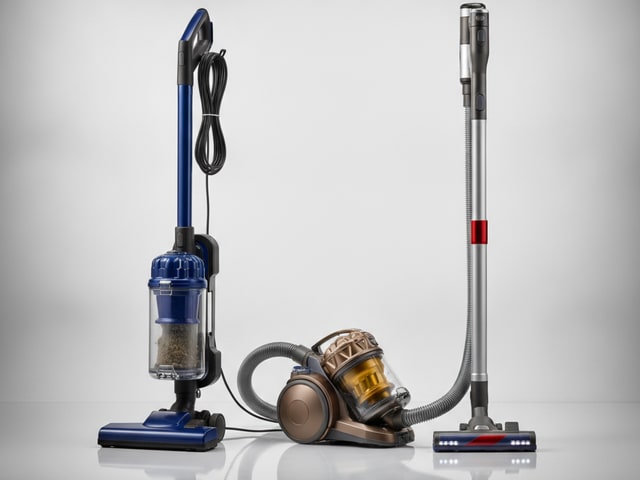
An upright vacuum is a single vertical unit where the motor, dustbin, and cleaning head all live in one body you push across the floor. A canister vacuum, also called a cylinder or barrel vacuum, splits those components into two separate parts. A wheeled canister houses the motor and dustbin, while a flexible hose connects it to a separate wand and cleaning head you hold in your hand.
Dreame, a vacuum manufacturer, published comparison data showing the structural weight split between the two designs. The wand on a cylinder model weighs roughly 2.6 lbs when you're holding it, while a full stand-up unit runs around 16.5 lbs as one piece. The heavy part rolls on the floor behind you, and your arm only guides the lightweight wand.
Upright vacuums compensate for their bulk with a feature canisters rarely match on carpet. An independently powered brushroll built into the cleaning head rotates against carpet fibers and pulls embedded debris up to the suction path. Modern uprights from brands like Shark lean heavily on this design for carpet performance, and it works. The downward weight of the unit combined with the brushroll gives push-style vacuums a real edge on medium-to-thick pile.
Barrel-style vacuums take a different approach. Instead of relying on a brushroll, they focus on suction-centric airflow and make up for the lack of agitation with a wider range of interchangeable attachments. That flexibility is what makes them useful for stairs, upholstery, drapes, and hard floors, tasks where a brushroll is either unnecessary or actively unhelpful. If you want to understand how those attachments actually work, the Vacuum Attachments Explained guide breaks down which tools are worth using and when.
Both designs clean floors. The difference is which floors, and how much else you need the vacuum to do beyond that.
Canister vs upright: side-by-side specs comparison
Canisters and uprights overlap more than most buyers expect on price and bin size, but they split sharply on weight, noise, and how many tools come in the box. The table below pulls together figures from Dreame's comparison data, Yahoo's market research, and Abt, a home appliance retailer, so you can see the full picture at once.
Spec | Canister Vacuum | Upright Vacuum | Edge Goes To |
|---|---|---|---|
Weight (total unit) | 7.5–17 lbs | 10–17 lbs | Canister (lighter floor-rolling body) |
Weight in hand | ~2.6 lbs (wand only) | 10–17 lbs (full unit) | Canister (much lighter to hold) |
Suction power | ~250 air watts (typical) | ~180 air watts (typical) | Canister on paper; model-dependent in practice |
Cleaning path width | ~11 inches | ~13 inches | Upright (covers more floor per pass) |
Dustbin capacity | 0.95–2 L | 0.84–1.9 L | Roughly equal |
Storage footprint | ~2.2 sq ft | ~1.1 sq ft | Upright (fits in narrower closets) |
Noise level | ~60–65 dB | Louder (varies by model) | Canister (quieter in use) |
Standard attachments | 5–6 tools | 2–3 tools | Canister (more versatile out of the box) |
Price range | ~$88–$500 | ~$120–$440 | Roughly equal (ranges overlap) |
Several rows in that table need more context than a single cell can hold.
Suction figures above are typical design-class averages from Dreame, not a ceiling. Real-world performance varies a lot by model. Wirecutter's testing found the Miele Guard M1 canister hitting 900 CFM at max, while the Shark PowerDetect upright cleared 800 CFM, a threshold Wirecutter describes as impressive. The Shark Navigator upright and SEBO Airbelt K3 canister both landed around 600–650 CFM. A well-specced stand-up model can outpull a budget cylinder vacuum, so the air watts column above is a starting point, not a verdict. If you want to understand what CFM and air watts actually translate to in cleaning performance, the Vacuum Suction Power Guide breaks down both units in plain language.
Noise is one area where the canister's design gives it a structural advantage. The motor sits inside the wheeled body on the floor, farther from your ears, which is part of why cylinder vacuums tend to run quieter. Uprights place the motor right at the cleaning head, closer to you as you push. That difference matters if you vacuum while a baby sleeps or live in an apartment with thin walls.
Storage footprint reliably favors uprights. A stand-up vacuum stands in a narrow closet corner without taking over the space. A canister needs about twice that floor area, and you still have to coil the hose somewhere. If your storage situation is tight, that gap is real.
No single design wins across every row, which is exactly why floor type and home layout end up being the tiebreakers for most buyers.
How does floor type affect which design cleans better?
Floor type is where the canister versus upright decision gets clearest. Uprights win on medium-to-thick carpet, and canisters win on hardwood, tile, and laminate.
Carpet performance comes down to the brushroll. An upright's powered brushroll spins against the pile, agitating fibers so embedded grit, hair, and debris loosen and get pulled into the airflow. Add the downward weight of the full unit pressing the cleaning head into the carpet, and you get a combination that a canister's suction-only head struggles to match on dense pile. A home with wall-to-wall carpet is better served by an upright for this reason.
Hard floors flip the advantage. On hardwood, tile, or laminate, a brushroll is a liability rather than an asset. It can scatter lightweight debris across the room before suction catches it, and the stiff bristles risk scratching delicate finishes. A canister's wand gives you precise, low-speed control over the cleaning head, and the lighter touch means debris stays where you want it. If you're shopping for bare floors, the Best Hardwood Floor Vacuums Under $120 guide covers no-scratch picks worth considering alongside full-size canisters.
Mixed-surface homes are where the gap between designs shows up most in daily use. Cylinder vacuums with lighter wands and suction-centric heads transition between an area rug and bare floor more smoothly than most uprights, which tend to be optimized for one surface type. If your rooms alternate between rugs and hardwood, that flexibility adds up over a week of cleaning.
Raw suction also favors canisters in at least one direct comparison. An independent YouTube comparison using Hoover upright and canister models measured roughly 50 to 53 inches of working vacuum on the canister against about 35 inches on the upright. That's a meaningful gap in pull strength, though it reflects one specific pair of models rather than every product on the market. Treat that result as a directional signal rather than a universal rule.
Uprights are the more efficient choice for homes that are mostly carpet. Canisters handle bare floors, or a mix of bare floors and rugs, with smoother transitions and better control over delicate surfaces.

Which design handles stairs, furniture, and tight spaces?
Canister vacuums handle stairs, tight spaces, and above-floor cleaning more comfortably than uprights, while uprights move faster across large open rooms with nothing in the way.
Stairs are where the design difference becomes impossible to ignore. With a cylinder vacuum, the wheeled body sits on one step while you work the lightweight wand up and down the rest of the staircase. Your arm only moves a fraction of the upright's total weight. A stand-up model gives you no such option. You carry the full unit, step by step. On a two-story home with a full flight of stairs, that adds up to a tiring job every time you vacuum. Multi-story households almost universally find canisters easier to live with for this reason alone.
Furniture clearance is the other place where the canister's low-profile wand earns its keep. A canister wand slides under low sofas and beds without you having to move anything. Uprights are bulkier at the cleaning head and often can't fit beneath low furniture at all, which means you're either skipping those spots or rearranging the room before you vacuum. Neither is a great option on a busy weekday.
Above-floor cleaning, things like drapes, bookshelves, upholstery, and ceiling corners, is where canisters pull farthest ahead. The hose-and-wand setup is built for this. Swap to a dusting brush or upholstery tool, and the canister body stays on the floor while you reach wherever you need to go. Uprights can do above-floor work too, but most require you to detach a hose and hold the main unit awkwardly while you clean. It works, but it's clumsy enough that most people skip it. The Vacuum Attachments Explained guide covers which tools are actually worth using for these tasks.
Open rooms flip the advantage back to uprights. Pushing a single unit across a large carpeted living room or bedroom is faster and simpler than managing a canister body trailing behind you on a hose. There's no hose to step over, no canister to reposition when you change direction. For a single-story home with wide-open rooms and minimal furniture to navigate around, that simplicity is a real benefit. The Compact Storage Vacuums guide has options worth comparing if closet space is a deciding factor for you.
Ergonomics, weight, and noise: comfort factors compared
Canister vacuums are easier on your body during a full cleaning session, mainly because the heaviest part never leaves the floor. The wand you hold is light. An upright puts its entire weight into the unit you push, steer, and lift every time you change direction or move to a new room.
The weight gap matters more than the raw numbers suggest. Pushing an upright across carpet takes consistent arm and shoulder effort, especially on thicker pile where the cleaning head resists movement. With a barrel-style vacuum, your arm guides a lightweight wand while the rolling body follows behind. Over a 30-minute cleaning session covering multiple rooms, that distinction adds up. Shark's product guidance notes that canisters tend to be more manageable for people with mobility problems in hands, arms, or shoulders, for exactly this reason.
Noise is the other comfort factor where the two designs split clearly. Canisters typically run at around 60 to 65 dB, according to Abt's buying guide. Uprights tend to run louder, though the exact level varies by model. The structural reason is straightforward. A canister's motor sits inside the wheeled body on the floor, several feet away from your ears, while an upright places the motor right at the cleaning head, directly in front of you as you push. That gap is worth factoring in if you vacuum while a child naps, share walls with neighbors, or just find loud appliances draining. The Quietest Vacuum Cleaners Under $100 guide covers specific models if noise is a priority for you.
Cord and hose management is one area where neither design has a clean advantage. A canister adds a hose between the body and the wand, which gives you extra flexibility to clean above-floor surfaces without moving the main unit. The downside is that the hose is one more thing to manage, step over, and coil up when you're done. Some people find it annoying. Others barely notice it after a few uses.
Weight-conscious shoppers who want a machine that's light to carry between rooms should also look at the Best Lightweight Vacuums Under 8 Pounds guide, which covers canister and upright options that keep the total unit weight low enough to carry up stairs without strain.
Filtration, allergens, and pet hair: which design helps more?
Filter type matters far more than vacuum design for people with allergies. HEPA filters are available in both canister and upright vacuums, so choosing between the two formats won't determine whether you get proper allergen capture. What determines that is whether the specific model you buy uses a true HEPA filter in a fully sealed housing, not whether it's a canister or an upright. The HEPA Filter Explained guide breaks down the difference between true HEPA and HEPA-type filters, which is the distinction that actually affects air quality in your home.
Pet hair on carpet is where uprights hold a real advantage. A powered brushroll digs into carpet pile and pulls shed fur up to the suction path in a way that a suction-only head can't replicate on dense or medium-pile carpet. A heavy shedder and wall-to-wall carpet is a combination that an upright handles more efficiently.
Upholstery, bedding, and stairs tell a different story when fur is the problem. Cylinder vacuums are better suited for those surfaces because the wand and specialized attachments reach them naturally. You can run an upholstery tool across a sofa cushion or a pet bed without repositioning the main unit, and the same setup works on stairs without carrying a heavy machine step by step. Uprights can do upholstery work with a detachable hose, but the process is awkward enough that most people skip it. The HEPA Filters for Pet Allergies guide covers affordable models in both formats that handle fur and filtration together.
Bagged versus bagless is the other filtration factor worth thinking through, and it applies equally to both designs. Bagged models, whether canister or upright, tend to contain allergens better at disposal. You seal the bag and toss it. With a bagless model, emptying the dustbin releases a small cloud of fine particles back into the air, which is a real concern if anyone in your home has asthma or dust allergies. The Bagged versus Bagless Vacuums breakdown covers the ongoing cost difference too, since replacement bags add up over time in ways that bagless filters don't.

Long-term cost of ownership: bags, filters, and maintenance
Upfront price alone won't tell you which design costs more to own over time. Canisters run roughly $88 to $500 and uprights $120 to $440, so the ranges overlap enough that neither type is automatically the budget choice. The real cost difference shows up in what you buy after the vacuum leaves the box.
Bagged models in both designs require replacement bags on a regular schedule. That's an ongoing expense whether you choose a canister or an upright. Bagless models skip the bags but need periodic filter cleaning and eventual filter replacement instead. Neither approach is free to maintain, and the Bagged vs. Bagless Vacuum Costs breakdown covers exactly how those costs compare over a typical ownership period.
Canister vacuums have more separate components than uprights, including the hose, wand connections, and attachment ports. More parts means more potential points of wear over time. Uprights have a simpler component layout, which can make troubleshooting easier when something goes wrong. If long-term reliability matters to you, the Vacuum Warranty Guide explains what manufacturer coverage typically includes and where it stops. For keeping either design running well between service calls, the Vacuum Maintenance 101 guide covers the basics that most owners skip.
How to choose: match the vacuum design to your home
Five questions will tell you which design fits your home better than any spec sheet will. Work through them in order, and the right answer usually becomes clear before you reach the end.
Assess your flooring first. Mostly carpet, especially medium-to-thick pile, points toward an upright. The powered brushroll and broader cleaning path cover carpeted rooms faster and pull more embedded debris out of the fibers. Mostly hard floors, or a mix of hardwood and area rugs, points toward a canister. The lightweight wand gives you better control on bare surfaces, and a multi-surface cleaning head handles transitions between rugs and hardwood more smoothly. A home that's split down the middle should lean canister, since it handles both surfaces more gracefully than an upright handles hard floors.
Count your levels and stairs. A multi-story home with a full staircase is the single strongest argument for a canister. The rolling body parks on one step while you work the wand up and down the rest of the flight, and your arm only moves a fraction of the upright's total weight. A single-story open-plan home removes that argument entirely, and an upright's simplicity, one unit with no hose to manage, becomes a real advantage for covering large rooms quickly.
List the cleaning tasks you actually do regularly. Floor cleaning alone favors whichever design matches your flooring. Add upholstery, drapes, under-bed cleaning, or car interiors to that list, and a canister pulls ahead. The hose-and-wand setup reaches those surfaces naturally, and most canisters ship with more attachments compared to a typical upright. If you already know you want to use your vacuum for more than floors, the Vacuum Attachments Explained guide shows which tools are actually worth grabbing for each task.
Check your storage situation honestly. An upright takes up about half the floor space of a canister setup and stands in a narrow corner without issue. A cylinder vacuum needs roughly double that area, and you still have to coil the hose somewhere nearby. In a small apartment or a home with one shallow utility closet, that difference is real. The Compact Storage Vacuums guide covers specific models worth comparing if closet space is a hard constraint.
Factor in physical comfort. A canister keeps most of the machine's mass on the floor and puts only the wand in your hand, which matters over a 30-minute cleaning session and matters a lot if you have shoulder, arm, or hand mobility issues. An upright's single-unit design is simpler to operate if you'd rather avoid managing a trailing hose and canister body, especially across large open rooms where you're not navigating around much furniture. Before you finalize either choice, it's worth scanning the Red Flags When Buying Vacuums guide so you know which specs and marketing claims to ignore when you're comparing specific models.
Most buyers find that two or three of these five questions point the same direction. Flooring type and stairs are the tiebreakers if your answers split evenly, since those two factors affect every single cleaning session rather than occasional tasks.
Can you own both? When two vacuums make sense
Owning both a canister and an upright is a practical setup in large, multi-level homes. Good Housekeeping, a consumer product review publication, mentions that in that situation, having one of each can be prudent. An upright handles the main carpeted floors where its wide cleaning path and brushroll do their best work, while a canister takes care of stairs, hard floors, and above-floor tasks. You're not doubling up on the same job. You're covering two different jobs with the right tool for each.
Budget doesn't have to be a barrier to this approach. A mid-range upright for daily carpet cleaning paired with an affordable barrel-style vacuum for stairs and spot tasks costs less than you might expect, since the price ranges for both types overlap heavily. A handheld vacuum is an even cheaper alternative for stair treads and upholstery if you already own a solid upright and just need something portable for those surfaces.
A cordless stick vacuum is the third option worth considering. It doesn't replace either a canister or an upright for thorough full-home cleaning, but it fills the gap between full sessions. Grab it for a quick kitchen sweep, a spill on the stairs, or a fast pass through a high-traffic hallway without dragging out the main machine. The Cordless vs Corded Stick Vacuums guide covers how battery life and suction hold up against corded designs, which matters if you're thinking of a stick as a daily driver rather than a supplement.
Most households don't need two full-size vacuums. A single canister covers enough ground to be the only machine in a mixed-floor home. But if you have a large carpeted upstairs, a hardwood main level, and a staircase connecting them, splitting the job between an upright and a lighter secondary machine is often the most practical answer.
Frequently asked questions
Are canister vacuums more powerful than upright vacuums?
Not automatically. Suction depends far more on the specific model than on the design type. A Wirecutter comparison measured the Miele Guard M1 canister at 900 CFM while the Shark Navigator upright came in around 600–650 CFM, but the Shark PowerDetect upright cleared the 800 CFM threshold that the same reviewers called impressive. Check the specs on the individual model, not just the design category.
Which vacuum type is better for hardwood floors?
Canister vacuums handle bare floors better for most people. The wand is light and easy to control, and you're not dragging a heavy head across surfaces that don't need aggressive agitation. The separation of the motor body from the cleaning head is what makes the difference on smooth floors.
Do upright vacuums clean carpets more deeply than canisters?
Generally yes, especially on medium to thick carpet. Uprights use a powered brush roll that spins directly into the pile, and the full weight of the unit helps press the head into the fibers. A canister with a motorized floor head can close the gap, but a basic canister with a suction-only nozzle will usually fall short on dense carpet.
What type of vacuum is easiest to use on stairs?
Canister vacuums win on stairs without much debate. You carry or park the canister at the top or bottom and use the lightweight wand to clean each step, rather than hauling a full upright unit up and down. The hose-and-wand setup is exactly what stair cleaning calls for.
Are canister vacuums quieter than uprights?
Most are. Canisters typically run quieter than uprights because the motor sits inside the wheeled body on the floor, farther from your ears. That difference is noticeable in daily use, especially if you vacuum while kids are sleeping or you're sensitive to noise.
Which vacuum type is easier to store in a small apartment?
Uprights take up roughly half the floor space of a canister setup. A narrow closet or tight utility corner almost always fits an upright more easily.
Is a canister or upright vacuum better for pet hair?
It depends on where the hair lands. For large carpeted rooms with heavy pet hair, an upright's wide cleaning path covers ground faster. For pet hair on furniture, stairs, and bedding, a canister's attachments give you far more flexibility to reach the spots that actually collect hair. Many pet owners end up wishing they had both.
Do canister vacuums cost more than uprights?
At the entry level, not by much. Canisters start around $88 and uprights around $120, so uprights can actually cost more at the low end. Mid-range and premium canisters tend to run higher once you factor in the extra attachments and more complex build, but the price ranges overlap across both types.
Can I use a canister vacuum on thick carpet?
Yes, but results vary by the floor head you use. A canister paired with a motorized brush roll attachment can clean thick carpet reasonably well. A basic suction-only nozzle will struggle to pull debris out of dense pile, so check what floor head comes included before you buy.