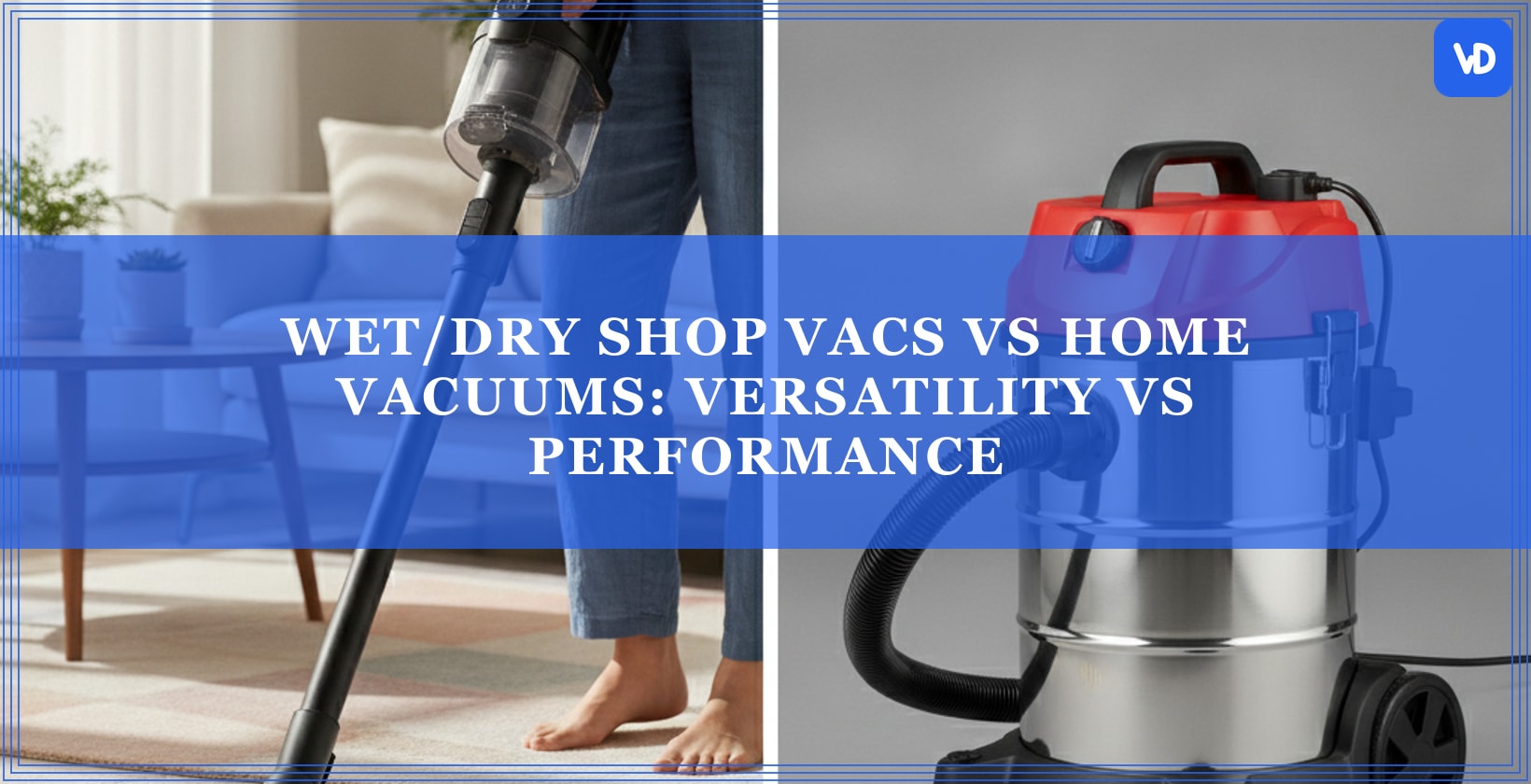
Wet/Dry Shop Vacs vs Home Vacuums: Versatility vs Performance
Wet/dry shop vacs are utility vacuums built for high airflow (75–150+ CFM) and liquid pickup in garages and workshops, while home vacuums are cleaning machines built for sealed suction (7,000+ Pa), carpet agitation, and fine-dust filtration for everyday indoor use. Most households benefit from owning one of each.
Vacuum cleaners built for homes and shop vacs built for garages look similar enough that the question is fair. Can one replace the other? The short answer is no, and the reason matters more than the answer. Home vacuums use powered brush rolls to agitate carpet fibers and lift embedded dirt — something no shop vac does, regardless of how many horsepower the motor claims.
Shop vacs handle wet spills, sawdust, drywall dust, and flood cleanup that would destroy a household vacuum's motor in minutes. VacuumWars, an independent vacuum review channel, found wet/dry vacs averaged 197 CFM of airflow versus 83 CFM for upright home vacuums — yet the shop vacs still lost on carpet cleaning because raw airflow without brush agitation barely touches dirt worked into carpet pile.
CFM and Pa aren't just different numbers. They measure completely different things, and understanding what CFM and Air Watts actually mean changes how you read every spec sheet on both types. A shop vac moving enormous air volume still can't replicate what a sealed suction system does for fine dust and allergens.
Homeowners with a garage, a car to detail, or a single water emergency will find this comparison settles a real decision. Each section below covers a different angle, from suction specs to storage to whether buying both is the smarter spend.
What separates a wet/dry shop vac from a home vacuum?
Wet/dry shop vacs and home vacuums are built around completely different priorities, which is why one can't reliably replace the other. Shop vacs are designed around airflow volume and tank capacity. Consumer vacuums are designed around suction pressure, brush agitation, and filtration quality.
The term "shop vac" started as a brand name. The original Shop-Vac brand launched the product category, and the name stuck as a generic label for any wet/dry utility vacuum. Most shop vacs on the market today are wet/dry capable, meaning they can safely pick up liquids without damaging the motor. Not all of them are, though, so check before you point one at a puddle.
Tank capacity is where shop vacs immediately stand apart. Sizes run from 2.5 gallons for compact portable units up to 16 gallons or more for heavy-duty models. Shop vacs are built for jobs where debris accumulates fast. Sawdust from a table saw, drywall dust after a renovation, a flooded basement corner, or a car interior full of sand and gravel all pile up quickly. A household vacuum's dustbin, typically under two gallons, would fill and choke on any of those jobs in minutes.
Standard vacuums take a different approach entirely. Instead of moving large volumes of air, they focus on sealed suction pressure, measured in Pascals, and on powered brush heads that spin against carpet fibers to physically dislodge dirt that's worked into the pile. That combination is what actually cleans carpet.
A shop vac, regardless of motor horsepower, has no rotating brush head. High airflow alone barely touches dirt deep in carpet fibers. The Vacuum Suction Power Guide covering CFM and Air Watts breaks down exactly what each metric measures and where it matters.
Filtration is the other major gap. Household vacuums, especially those with true HEPA filters, are built to trap fine particles and keep them out of the air you breathe. Standard shop vac filters handle large debris well but allow more fine dust to recirculate indoors. That's fine in a garage. In a living room, it's a problem, particularly for anyone with allergies or asthma.
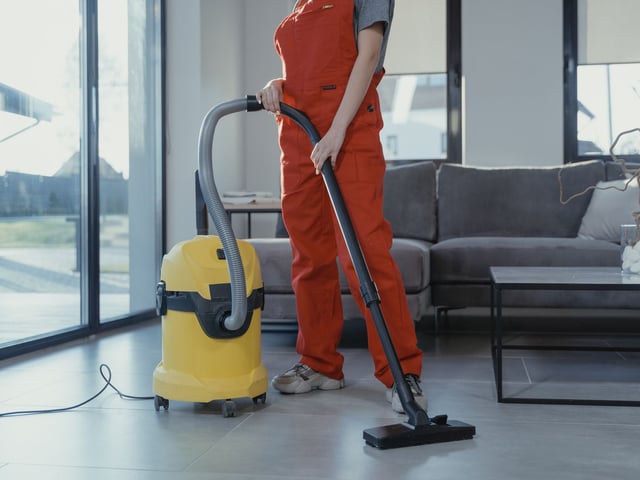
Versatility vs performance: side-by-side comparison
Shop vacs win on versatility. Consumer vacuums win on daily cleaning performance.
Feature | Wet/Dry Shop Vac | Home Vacuum |
|---|---|---|
Primary suction metric | CFM (airflow) + water lift (inches H₂O) | Pascals (Pa) or Air Watts |
Liquid pickup | Yes — designed for it | No — risks motor damage |
Typical tank capacity | 2.5–16+ gallons | Under 2 gallons (dustbin) |
Carpet cleaning ability | Poor — no rotating agitator bar | Strong — powered beater bar agitates fibers |
Filtration quality | Basic (standard cartridge); HEPA available as upgrade | HEPA available on many models |
Noise range | 70–85 dB (some models louder in lab tests) | 60–75 dB |
Portability | Rolling canister; bulky on stairs | Upright, stick, or canister; designed for room-to-room use |
Price range | ~$50–$500+ | Varies widely by type |
Each tool in the table above is built for conditions that would either damage or simply frustrate the other. That's why they rarely overlap in practice.
Where shop vacs have the clear edge
Wet/dry shop vacs handle the jobs that would wreck a household vacuum outright. Flooding, pipe leaks, wet sawdust, drywall dust from a renovation, a car trunk full of gravel — none of those are edge cases for a shop vac. They're exactly what it's built for. A consumer vacuum pointed at standing water risks immediate motor damage. A utility wet/dry vac handles it safely.
Tank size is another practical advantage. A 16-gallon unit like the Craftsman 16-Gallon wet/dry vac can run through a large garage cleanout without stopping to empty. No household vacuum dustbin comes close to that capacity for high-volume debris.
Car interiors are a third area where shop vacs outperform. The combination of high airflow, flexible hose, and narrow nozzle attachments reaches into seat tracks and floor mat edges better than most consumer vacuum attachments. You'll get more done detailing a car with a shop vac than with a standard upright.
Where home vacuums win for daily use
Carpet cleaning is where household vacuums pull ahead, and the reason has nothing to do with suction numbers. Powered beater bars spin against carpet fibers and physically dislodge pet hair and fine dust. Shop vacs have no equivalent mechanism. You can run one over carpet all day and still leave behind what a consumer vacuum lifts in one pass.
Filtration separates the two categories just as sharply. Household vacuums with true HEPA filters trap fine particles and keep them out of the air. Standard cartridge filters on most utility vacs are built for large debris, not allergens. For anyone managing dust allergies or asthma indoors, that difference matters more than any airflow figure.
Everyday maneuverability also favors consumer vacuums. Uprights and canisters are designed to get around furniture, reach under beds, and move between rooms without effort. A rolling shop vac canister is manageable in a garage but awkward on stairs or in a hallway. Both canister and upright designs beat a shop vac for daily floor care in living spaces.
How suction specs differ between shop vacs and home vacuums
Shop vacs and household vacuums report performance in completely different units, which is why comparing their numbers directly tells you almost nothing useful.
Shop vacs use CFM (cubic feet per minute) for airflow volume, and water lift measured in inches of water for sealed suction. Consumer vacuums use Pascals (Pa) or Air Watts instead. CFM tells you how much air a machine moves per minute. Pa tells you how much concentrated pressure it generates at the nozzle. A shop vac built for high CFM sweeps large volumes of debris into a tank fast. A household vacuum built for high Pa pulls dirt out of carpet fibers against resistance. Those are different jobs, and the metrics reflect that.
TechGearLab, an independent product testing lab, measured the Craftsman 16-Gallon wet/dry vac at 274 CFM, an enormous volume of moving air. A consumer vacuum targeting deep carpet cleaning aims for 7,000 Pa or higher in sealed suction pressure. Neither number translates into the other. You can't convert CFM into a Pa figure and declare a winner, because one machine is built for volume and the other for concentrated pressure. The Vacuum Suction Power Guide on CFM and Air Watts covers the mechanics clearly.
Peak horsepower ratings on shop vacs add another layer of confusion. Popular Mechanics cautions that peak HP is not the most accurate way to compare wet/dry vacs, and Home Depot notes that more horsepower does not necessarily mean a better wet/dry vac. Peak HP reflects the electrical draw at motor stall, not the sustained output during normal cleaning. A shop vac rated at 6.5 peak HP doesn't run at that level while you're vacuuming sawdust. Amperage and CFM give you a more honest picture of real-world performance than the HP number on the box.
Hose geometry matters more than most buyers expect. A higher-HP shop vac fitted with a long, narrow hose can actually underperform a lower-HP model running a shorter, wider hose. Friction losses increase with hose length, and a narrower diameter restricts airflow regardless of motor power. Home Depot's buying guide flags this directly. A 2.5-inch hose moves meaningfully more air than a 1.25-inch hose at the same motor rating, so check hose diameter alongside the CFM figure before buying.
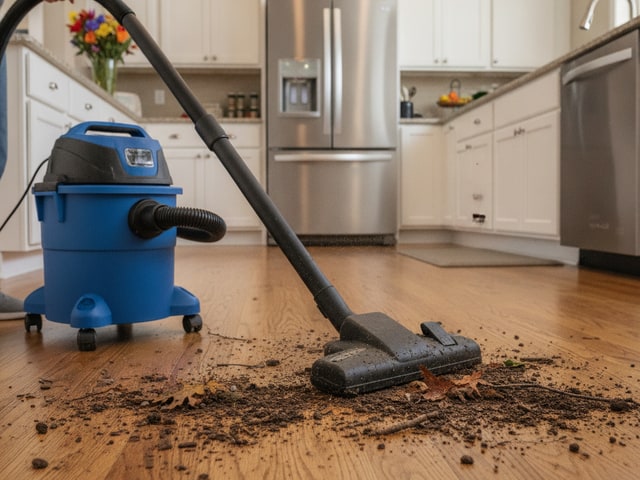
When a wet/dry shop vac makes sense for home use
A wet/dry shop vac earns its place in a home the moment you face a mess that would damage or overwhelm a standard vacuum. These are the situations where reaching for a household vacuum is the wrong call.
Garage, workshop, and basement cleanup. Sawdust, wood shavings, drywall dust, nails, and chunks of debris will clog a consumer vacuum's filter fast and can damage the motor. A wet/dry shop vac handles all of it. The large tank means you can clear a full workshop floor without stopping to empty every few minutes.
Water and liquid emergencies. A flooded basement corner, a burst pipe, or a large spill on a hard floor are jobs a household vacuum cannot touch. Running a standard vacuum over standing water risks motor damage. A wet/dry shop vac is built for liquid pickup, and for this job there is no substitute.
Car detailing. Shop vacs with narrow slot attachments reach into seat tracks, under floor mats, and into trunk corners better than most consumer vacuum attachments. The combination of high airflow and flexible hose length gives you real reach in tight spaces. The Vacuum Attachments Explained guide covers which tools actually earn their place.
Renovation and construction cleanup. Post-project debris, including drywall chunks, tile grout, plaster dust, and construction grit, comes in volumes and particle sizes that exceed what household vacuums are built to handle. A 12- to 16-gallon shop vac can clear a gutted bathroom in one pass. A consumer vacuum would fill, choke, and potentially overheat trying to do the same job.
Outdoor and porch cleanup. Leaf litter on a covered porch, patio debris after a storm, or gutter cleanout are all tasks where dragging a household vacuum outside makes no sense. A shop vac handles outdoor grit and wet leaves without the filtration concerns that come with using one indoors on fine dust.
Debris type, not debris volume, is the common thread across all five situations. A wet/dry shop vac belongs in your cleaning lineup when the mess involves liquids, heavy particles, or construction material.
Why home vacuums still win for everyday floor cleaning
Consumer vacuums outperform shop vacs on daily floor cleaning because they have a powered beater bar and shop vacs don't. That rotating bar spins against carpet fibers and physically dislodges pet hair and fine dust. Without it, you're relying on airflow alone, and airflow alone barely touches dirt deep in the pile. This is why users report disappointing carpet results from shop vacs despite the machines feeling impressively loud and strong.
Pet hair makes the gap even more obvious. On carpet, hair wraps around fibers and resists suction. A beater bar combs through and lifts it. A shop vac nozzle just passes over the top. An upright or stick vacuum built for pet hair will outclean any shop vac on that specific job, regardless of tank size or motor rating.
Maneuverability is the third practical edge. Household vacuums are built around the spaces people actually clean. Low-profile heads slide under sofas, swivel steering handles tight corners, and lightweight frames make carrying up a flight of stairs a non-event. A shop vac canister on wheels is manageable in a garage. On a staircase or in a narrow hallway, it's awkward enough that you'll avoid using it. Noise compounds this, too. Consumer vacuums typically run at 60 to 75 dB, while shop vacs land between 70 and 85 dB, with some lab-tested models hitting much higher. Running a shop vac indoors for a full cleaning session is noticeably more fatiguing.
Floor type versatility also favors household vacuums for finished living spaces. Most uprights and canisters switch between carpet and hard floor modes, adjusting the agitator height or disabling it entirely to avoid scattering debris on hardwood or tile. Shop vacs have no equivalent adjustment. They work on hard floors, but without a floor head designed for the surface, they can push lightweight debris around rather than capturing it cleanly.
Filtration, noise, and indoor air quality: the hidden tradeoffs
Standard shop vac filters are built for sawdust and debris, not the fine particles that actually damage your lungs or trigger allergies indoors. Run a shop vac over drywall dust or sanding residue without a fine-dust or HEPA filter installed, and a meaningful portion of those particles gets blown back into the room. You can't see it happening, but the air quality in your living space drops while you clean.
Drywall dust is a good example of why this matters. The particles are fine enough to stay airborne for hours, and standard cartridge filters on most shop vacs aren't rated to capture them reliably. The same applies to sanding residue from wood finishing or plaster work. A fine-dust filter or HEPA upgrade isn't optional for indoor renovation cleanup. It's the difference between cleaning the room and redistributing the problem.
HEPA-rated filters do exist as aftermarket upgrades for several shop vac brands, but there's a real tradeoff. A denser filter restricts airflow more than a standard cartridge, which means the raw airflow that makes utility vacs useful for heavy debris drops when you add one. You get better filtration at the cost of debris-clearing speed. Most shop vacs ship with standard filters, so budget for the upgrade separately and check compatibility before you buy.
Noise levels separate these two categories just as sharply. TechGearLab measured shop vac noise at 96 dB during testing. That's roughly comparable to a lawn mower running next to you. Most consumer vacuums land between 60 and 75 dB, which is noticeably quieter in a closed room. Running a shop vac indoors for a full cleaning session isn't just loud. It's fatiguing in a way that a household vacuum isn't, and disruptive to anyone else in the house.
For anyone managing allergies or asthma, a household vacuum with true HEPA-grade filtration is a meaningfully better choice for indoor air quality than any shop vac, even one with a HEPA filter upgrade. Sealed filter housing matters as much as the filter itself. Air that leaks around the housing or through gaps in the canister lets fine particles escape regardless of what the filter is rated for. Household vacuums designed around enclosed filtration keep those particles captured from intake to dustbin. The HEPA Filters for Pet Allergies guide covering five affordable vacuums is a practical starting point for allergy-focused decisions.
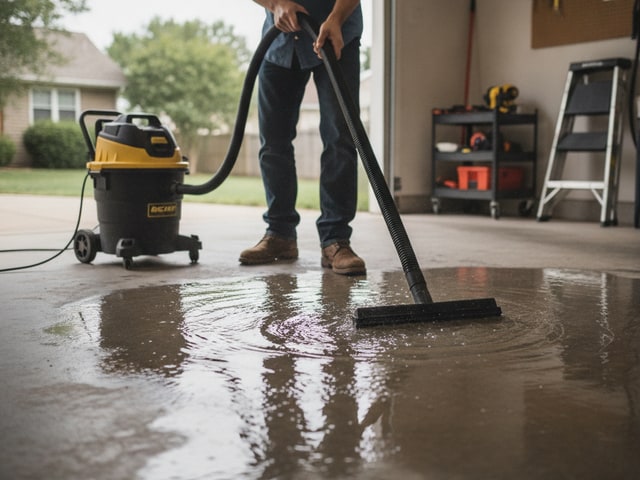
How to switch between wet and dry modes on a shop vac
Switching a wet/dry shop vac between modes takes about two minutes, but skipping a step can damage the motor or leave you with a machine that smells like mildew after one use. The filter setup is different for each mode, and getting it wrong is the most common mistake first-time owners make.
Dry mode setup: install the cartridge filter. Snap the standard cartridge filter onto the motor cage before vacuuming any dry debris. Without it, fine dust reaches the motor directly. For finer particles like sanding dust or pet dander, add a disposable dust collection bag inside the tank as a second layer. The bag catches most of the debris before it even reaches the filter, which extends filter life and makes cleanup faster.
Wet mode setup: swap the cartridge for a foam sleeve. Remove the cartridge filter entirely before vacuuming any liquid. A wet cartridge filter restricts airflow and can be permanently damaged by moisture. Slide the foam sleeve over the motor cage in its place. The sleeve protects the motor from water droplets while still allowing airflow. Some shop vac models are designed to run with no filter at all for liquid pickup, so check your manual before assuming the foam sleeve is required.
After wet use: empty, rinse, and dry before switching back. Empty the tank as soon as you're done. Rinse the tank with clean water, then let the foam sleeve air dry completely before reinstalling the cartridge filter for dry use. A damp sleeve trapping debris is the main reason shop vacs develop that musty smell. Proper drying between uses is the single most effective maintenance habit you can build. The Vacuum Maintenance 101 guide covers this and other habits that extend the life of any vacuum.
Safety check before any liquid pickup. Confirm your specific model is rated for wet pickup before attempting it. Not every shop vac is a true wet/dry unit, and using a dry-only model on liquids risks motor damage or electrical hazard.
What to check before buying: shop vac vs home vacuum decision guide
Five questions will tell you which type you need before you spend a dollar. Work through them in order, and the answer usually becomes obvious by the third one.
What kind of mess do you deal with most often? Liquids, sawdust, construction debris, or anything that comes out of a renovation project means a wet/dry shop vac is not optional. A household vacuum cannot safely touch standing water or heavy grit without risking motor damage. Carpet dust, pet hair, and everyday dirt in finished rooms all call for a consumer vacuum, which handles those jobs better than any utility vac will.
What floor types do you clean, and how often? Daily carpet and hardwood cleaning in living spaces favors a household vacuum with a powered brush bar and fine filtration. A shop vac has no brush agitation, so it leaves dirt behind on carpet regardless of how strong the motor is. Daily or every-other-day cleaning of finished floors is a consumer vacuum's job.
Where will you store it? A 12- to 16-gallon shop vac needs a garage, utility room, or basement corner. Compact 2.5- to 5-gallon models fit in tighter spaces, but they sacrifice tank capacity, which limits how long you can run before stopping to empty. A compact shop vac covers occasional spills and vehicle cleaning without taking over your closet. The Compact Storage Vacuums guide covering six models that fit in tiny closets is worth a look when space is the deciding factor for your household vacuum choice too.
Do you have a garage, workshop, or car to maintain? Most households with any of those three benefit from owning both a shop vac and a consumer vacuum rather than trying to stretch one device across every job. A shop vac handles the garage floor, the car interior, and the occasional water emergency. A household vacuum handles the carpets and daily floor care. Trying to use a shop vac for everything means your carpets never get properly cleaned. Trying to use a consumer vacuum for everything means one wet spill or renovation project could end its life early.
Are you comparing shop vac models on horsepower alone? HP ratings on shop vac packaging reflect peak electrical draw at motor stall, not sustained cleaning output. A more useful check is hose diameter. A 2.5-inch hose moves meaningfully more real-world airflow than a 1.25-inch hose at the same motor rating, because friction losses in a narrow hose eat into performance regardless of what the motor can theoretically produce. Check the hose diameter alongside the CFM figure before buying. Specs that look suspicious or marketing that leans heavily on peak HP without listing CFM are red flags. The Red Flags When Buying Vacuums guide covering eight warning signs covers exactly what to watch for.
Shop vac performance by size class: what the tests show
Size class is the single most useful way to match a shop vac to your actual jobs, and TechGearLab's lab measurements make the performance gaps between classes concrete.
Size Class | Capacity / HP | Tested Models | Airflow (CFM) | Water Lift (inH₂O) | Best For |
|---|---|---|---|---|---|
Heavy-duty | 12–16 gal / 6+ HP | Craftsman 16-Gallon, Vacmaster Beast 14-Gallon, Ridgid 14-Gallon | 208–274 CFM | 50–94 inH₂O | Renovation cleanup, flood recovery, large garage jobs |
Mid-range | 5–12 gal / 3–5 HP | Stanley 6-Gallon, Vacmaster 12-Gallon | 94–102 CFM | 50–64 inH₂O | Garage maintenance, car detailing, workshop cleanup |
Compact | 2.5–4 gal / 1–3 HP | Armor All 2.5-Gallon, Amazon Basics 4-Gallon | 25–28 CFM | 59–74 inH₂O | Quick spills, small messes, tight storage spaces |
Heavy-duty class: 12–16 gallon
The Craftsman 16-Gallon wet/dry vac topped the lab's measurements at 274 CFM, the highest airflow in the test group. The Vacmaster Beast 14-Gallon came in at 223 CFM with a notably higher water lift of 94 inH₂O, making it the stronger choice when you need to pull liquid up from a low point, like a flooded basement floor. The Ridgid 14-Gallon landed at 208 CFM and 60 inH₂O, sitting between the two on both metrics.
Heavy-duty canisters belong in a garage or utility room, not a hall closet. Tank size alone rules out daily indoor use for most households, but for a post-renovation cleanout or a burst pipe, nothing in the compact or mid-range class comes close.
Mid-range class: 5–12 gallon
The Stanley 6-Gallon measured 102 CFM and 50 inH₂O in TechGearLab's tests. The Vacmaster 12-Gallon came in just below at 94 CFM and 64 inH₂O. Good Housekeeping categorizes middleweight models in the 75–100 CFM range, suited to garage maintenance and vehicle cleaning rather than heavy construction debris.
Mid-range models are the most practical choice for homeowners who want a shop vac for regular use without the storage footprint of a 16-gallon unit. A 6-gallon tank handles a full car interior or a garage floor sweep without constant emptying, and the machines are light enough to carry between the garage and driveway.
Compact class: 2.5–4 gallon
The Armor All 2.5-Gallon measured 28 CFM and 59 inH₂O. The Amazon Basics 4-Gallon came in at 25 CFM and 74 inH₂O. Good Housekeeping puts compact shop vacs in the 30–50 CFM range as a general category benchmark, so both of these models sit at the lower edge of that band.
Compact units trade raw airflow for portability. You can store either one in a closet, toss them in a car trunk, and pull them out for a quick spill or a small car cleanup. For anything larger, the tank fills fast and the lower CFM means you're working harder to move debris. A compact shop vac and a stick vacuum serve different roles in a small space. The Best Cordless Stick Vacuums for Studio Apartments guide covers the consumer-vacuum side of that comparison.
Matching size class to job type matters more than chasing the highest HP number on the box.
Do you need both?
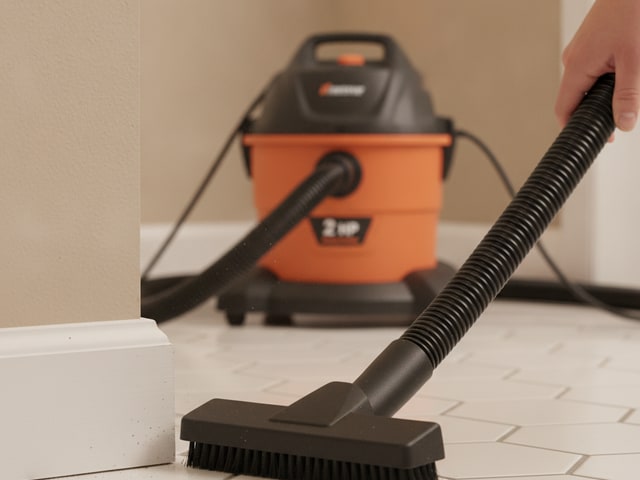
Most homeowners with a garage, workshop, or car to maintain are better off owning both a shop vac and a household vacuum. Trying to stretch either one into a job it wasn't built for just doesn't work.
A wet/dry shop vac and a consumer vacuum cover completely different ground. The utility vac handles liquids, heavy debris, and renovation cleanup. The household vacuum handles daily carpet and floor care with the brush agitation and filtration that a shop vac simply doesn't have. Use one for the other's job and either your carpets never get properly cleaned, or one wet spill ends your consumer vacuum's life early.
Apartment dwellers and renters without a garage or workshop are in a different situation. A quality upright, canister, or stick vacuum covers every realistic indoor cleaning task. A shop vac adds almost nothing to that setup. A cordless stick vacuum built for studio apartments covers the daily cleaning side without the bulk or noise of a shop vac.
Compact wet/dry vacs in the 4- to 6-gallon range are a reasonable middle ground for homeowners who want occasional spill coverage and vehicle cleaning without committing to a full-size unit. They store in a closet, handle a flooded floor mat or a garage spill, and cost far less than a heavy-duty model. They don't replace a household vacuum for daily use, but they fill the gap for the messes a consumer vacuum can't touch.
No single vacuum type does everything well. A wet/dry shop vac and a household vacuum are complementary tools, not competing ones.
Frequently asked questions
Can I use a shop vac as my regular home vacuum?
A shop vac can pick up dry debris from hard floors, but it lacks the rotating brush roll that lifts dirt from carpet fibers, so everyday carpet cleaning will disappoint you. Models like the Craftsman 16-Gallon run loud enough that daily indoor use gets uncomfortable fast. Most people who try it as a full replacement end up buying a household vacuum anyway.
Can a regular home vacuum pick up water?
Standard household vacuums cannot safely pick up water. Running one over liquid risks immediate motor damage and can create an electrical hazard. Only vacuums explicitly rated as wet/dry, like the Vacmaster Beast or Ridgid 14-Gallon, are designed for liquid pickup. Unplug the consumer vacuum and reach for a wet/dry unit instead.
Is a shop vac good for pet hair on carpet?
Shop vacs pull surface hair off hard floors reasonably well, but hair worked into carpet fibers needs a powered brush roll to agitate and release it. For a home with multiple carpeted rooms and shedding pets, a dedicated household vacuum with a motorized brushroll will outperform any utility vac on that specific job. A shop vac is better kept for the garage or post-grooming cleanup on tile.
What does CFM mean on a shop vac?
CFM stands for cubic feet per minute and measures how much air the vac moves through its hose per minute. Higher CFM means the vac sweeps debris into the tank faster, which matters more for large, loose material like sawdust or leaves than for fine dust deep in carpet. Consumer vacuums use Pascal (Pa) ratings instead, because sealed suction pressure matters more for pulling dirt out of carpet than raw airflow does.
Are shop vac HEPA filters as effective as home vacuum HEPA filters?
A HEPA filter on a shop vac captures fine particles at the filter itself, but most shop vac bodies are not fully sealed systems, so fine dust can leak around gaskets and back into the room before it even reaches the filter. Household vacuums designed for allergen control use sealed airpaths that force all air through the HEPA media. A sealed consumer vacuum is the safer choice for daily indoor use when air quality matters to you.
Why is my shop vac so loud compared to my home vacuum?
Shop vacs prioritize raw airflow over noise engineering, so their motors run wide open with minimal acoustic dampening. TechGearLab measured shop vac noise at around 96 dB in lab conditions, while most consumer vacuums sit noticeably lower because manufacturers tune them for living-space use. That gap is roughly the difference between a lawnmower and a quiet dishwasher, which is why shop vacs feel jarring indoors.
Can I safely vacuum drywall dust with a shop vac indoors?
A standard shop vac filter will clog quickly on fine drywall dust and can blow particles back into the air, which is a real health concern in enclosed spaces. You need a fine-dust or HEPA-rated filter cartridge installed before tackling drywall debris, and even then, ventilate the room well. Check that your specific model explicitly supports fine-dust filtration before you start. Not all do.
What size shop vac do I need for home use?
A 6- to 9-gallon model hits the right range between capacity and storage footprint for typical home tasks like garage cleanups, basement spills, and post-renovation debris. Compact 2.5-gallon units like the Armor All are easy to store but fill up fast on bigger jobs. The 14- to 16-gallon units (like the Craftsman 16-Gallon or Vacmaster Beast) are better suited to contractors or serious flood cleanup than to routine home use.
Do I need both a shop vac and a regular vacuum?
Most households do, yes. The two tools don't overlap well enough to replace each other. A shop vac handles wet spills, heavy debris, and garage messes that would wreck a consumer vacuum, while a household vacuum handles daily carpet and floor care far better than any shop vac can. Owning both is the practical answer when your home has finished living spaces and an unfinished garage or workshop.